Clover’s Ocean Explorer
Light in the Deep
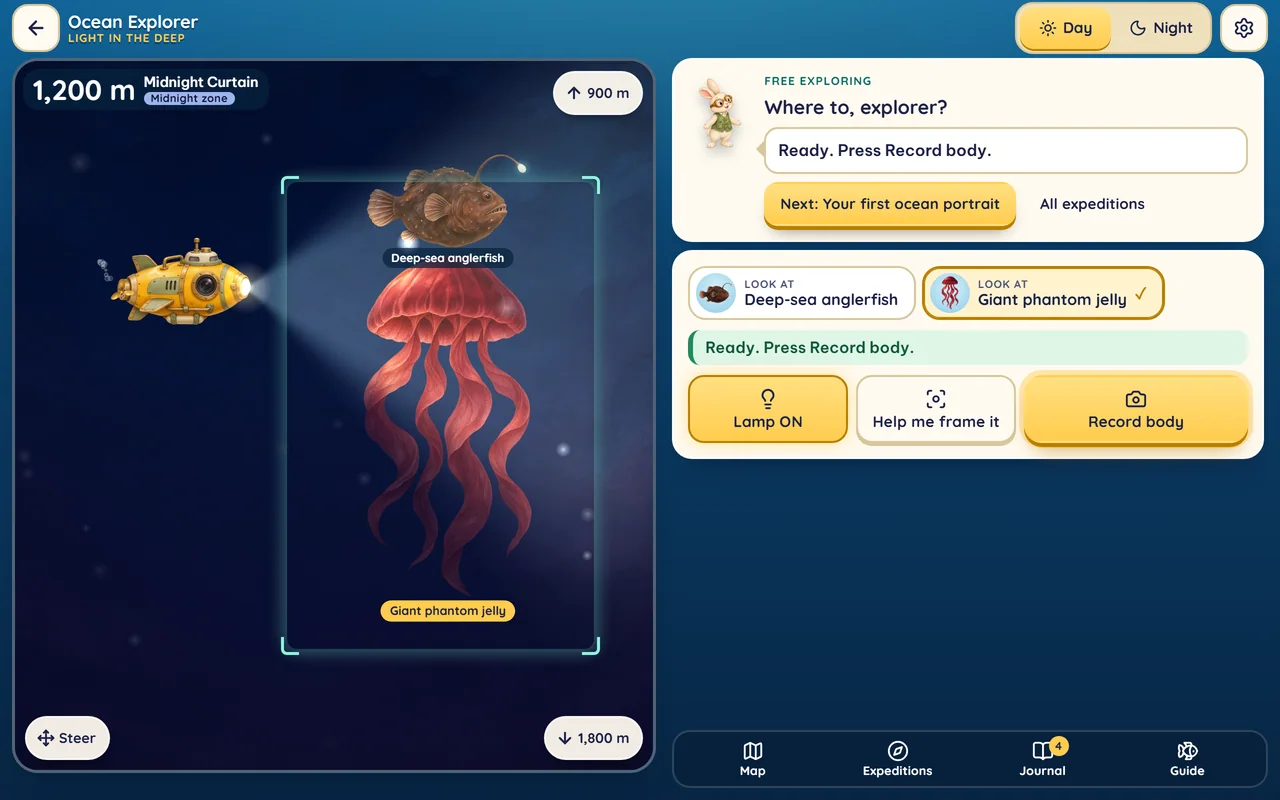
Take a little yellow submarine from the sunlit shallows down to a deep-sea trench. At each stop, look around, switch the lamp on and off, and ask what a scientist would ask: what can we really see here, and where is the light coming from?
Play the free gameNo account, purchase or email needed. Touch, mouse and keyboard controls, on phones, tablets and computers.
Take your dive onto paper
On a daytime dive, switch off the sub’s lamp. How much sunlight is left? Pick a sighting and draw it at the matching depth on your field sheet.
Dive, look, record
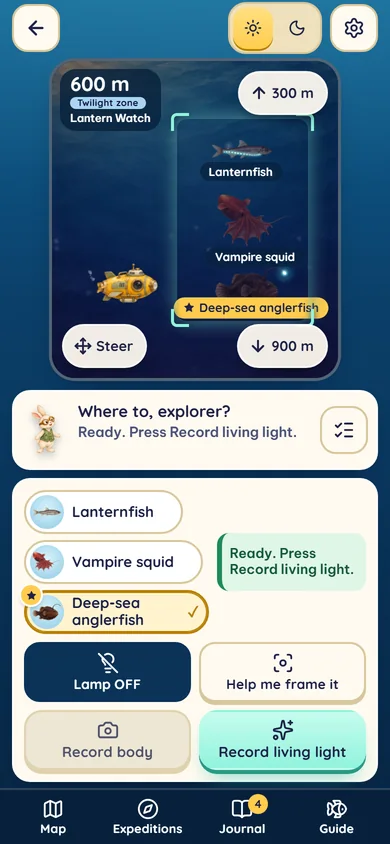
Visit 12 stops from 25 m down to 10,000 m. Pick an animal, switch the lamp on or off, and press Record. Every picture is saved with where, when and how it was seen: the depth, a day or night survey, and a body view or a living-light view. Nothing is scored, and nothing runs out.
Plenty to come back to
10 story expeditions, 20 replay expeditions with more than one good answer, 38 different pictures to collect (each animal at each stop it appears at, by day and by night, and the living light of the two animals that make their own), 26 badges that add up to 8 explorer ranks, 7 new colours to paint the sub, route planning, a small pass-the-device challenge maker and an album of up to 96 pictures. No timers, lives or streaks, and nothing to buy: every stop and expedition is open from the start.
Keepsakes and a quiet play space
Put up to 3 pictures on a journal page and save it as a picture file. The play area has no advertising pixels, retail analytics, shop offers or accounts, and progress stays in this browser. Sound, narration and movement each have their own switch.
From sunlight to the trench
Five depth zones, 12 stops. Daylight fades as the sub goes down, so the lamp matters more and more, and some animals make light of their own.
Sunlight zone
0 m to 200 m
- Sunbeam Bay (25 m)
- Blue-water Lookout (100 m)
Twilight zone
200 m to 1,000 m
- Fading Light (300 m)
- Lantern Watch (600 m)
- Snowfall Window (900 m)
Midnight zone
1,000 m to 4,000 m
- Midnight Curtain (1,200 m)
- Open-water Stage (1,800 m)
- Deep Ledge (3,000 m)
Abyss
4,000 m to 6,000 m
- Stilt Walk (4,500 m)
- Soft Seafloor (5,000 m)
Trenches
6,000 m to 11,000 m
- Trench Gate (8,000 m)
- Deep Research Stop (10,000 m)
Who is down there?
10 animals, from a green sea turtle that must come up for air to a tiny crustacean in a trench. Some swim in open water and some live on the seafloor. Only the lanternfish and the deep-sea anglerfish show their own light in the game, and that demonstration is scripted.
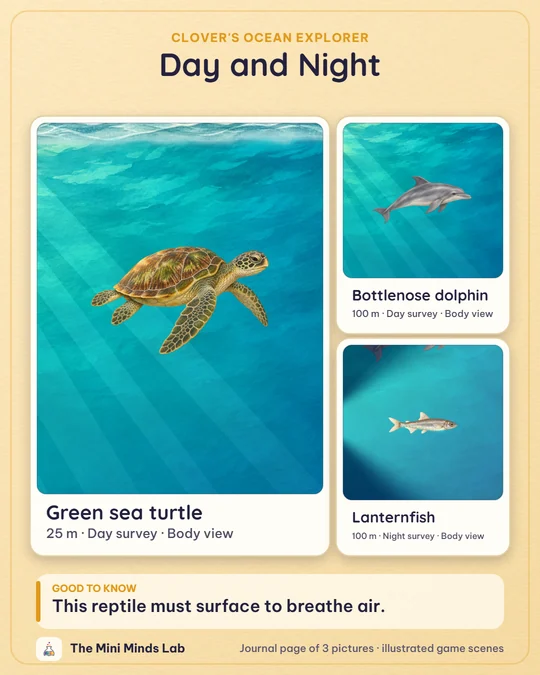
Green sea turtle
Chelonia mydas
This reptile must surface to breathe air.
Its shell and flippers help us recognise it.
In open water. Breathes air at the surface.
Source: noaa-turtle
Bottlenose dolphin
Tursiops truncatus
A dolphin is a mammal and breathes air.
Its blowhole is on top of its head.
In open water. Breathes air at the surface.
Source: noaa-dolphin
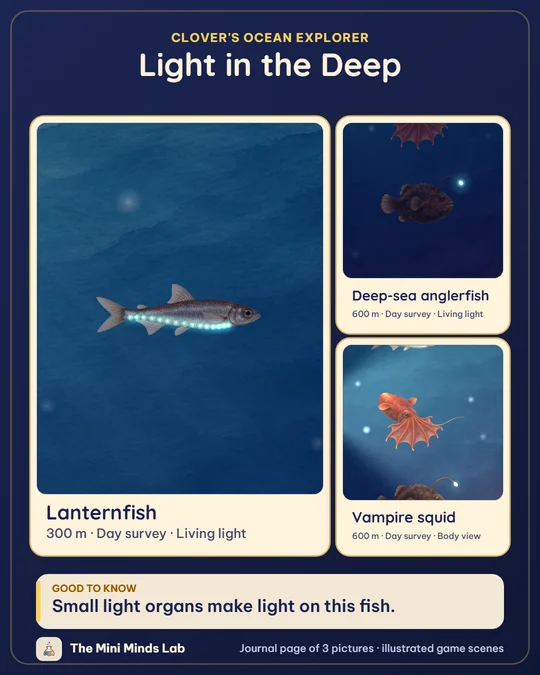
Lanternfish
Family Myctophidae; illustrative migrating example
Small light organs make light on this fish.
Many lanternfishes move into shallower water at night.
In open water. Lives in the water.
Source: whoi-lanternfish
Vampire squid
Vampyroteuthis infernalis
Thin feeding filaments gather sinking marine snow.
Despite its name, it does not drink blood.
In open water. Lives in the water.
Source: mbari-vampire
Deep-sea anglerfish
Female ceratioid teaching example
A light-producing lure can attract prey.
The light comes from bacteria living in the lure.
In open water. Lives in the water.
Source: mbari-angler
Giant phantom jelly
Stygiomedusa gigantea
Four long ribbon-like mouth arms trail below its bell.
Scientists still have many questions about this animal.
In open water. Lives in the water.
Source: mbari-phantom
Dumbo octopus
Grimpoteuthis spp.
Its paired fins help it move above the seabed.
A web links its eight arms.
At or near the seafloor. Lives in the water.
Source: si-dumbo
Tripod fish
Bathypterois spp.; tripod-form teaching example
Long fin rays support its body above the sediment.
Those supports are parts of fins, not legs.
At or near the seafloor. Lives in the water.
Source: am-tripod
Sea pig
Scotoplanes spp.
A sea pig is a sea cucumber, not a pig.
Long tube feet lift it above the soft seafloor.
At or near the seafloor. Lives in the water.
Source: mbari-seapig
Hadal amphipod
Hirondellea gigas
This small crustacean lives in deep ocean trenches.
Life exists even in waters deeper than 10,000 metres.
At or near the seafloor. Lives in the water.
Source: idsse-amphipod
A journal page to keep
A page holds one to three real pictures, a title from a fixed list, a style and one short fact. Each picture keeps its label: the animal, the depth, the survey and the view. It is drawn on the device and saved as a picture file that looks just like the one on screen. Children never type names or messages, and a page never shows a name or a date.
Made for small hands and any screen
The same game fits a phone held upright or sideways, a tablet and a computer. Big buttons, no dragging and no quick reactions are needed: a Help me frame it button lines an animal up for you, and every spoken word is also written on screen.
For grown-ups
What children practise
- Noticing that daylight fades with depth, and that a vehicle’s lamp and an animal’s own living light are different sources of light.
- Observing before explaining: framing an animal, choosing a body view or a living-light view, and saving where, when and how it was seen.
- Comparing animals that breathe air or water, that swim in open water or live on the seafloor, and the same animal in a day and a night survey.
- Planning: choosing one to three stops for a route that could give every picture an expedition asks for, and checking the plan before sailing.
- Telling a small story with evidence by choosing real saved pictures for a journal page.
Designed for ages 5–8 with grown-up support, with optional independent comparison and planning challenges for ages 7–10. A guided expedition takes about 3–6 minutes, and free exploring is always available. These are design targets that are still waiting for playtesting with children.
A teaching scenario, not a survey
The ocean in the game is an illustrated teaching scenario inspired by the sources below. Stops are example survey depths, not the full depth range of any animal and not one real dive. Each encounter is authored for the game: none is a specimen record, a count or a prediction of what a real expedition would find. The night survey shows one example of a daily migration, with lanternfish moving shallower after dark. The light demonstration is scripted. A picture that does not show an animal does not prove it is absent from the water, and the game says so. Small animals are drawn bigger than they really are so you can see them, and the pictures are not to one scale. Nothing in the game asks a child to catch, touch or disturb real wildlife.
Elevator rescue
A scrap of paper and a pencil
Set up. Draw ten boxes in a tower. Number them 1–10. Put a fingertip on floor 6 as the elevator.
Say it aloud. “Friends are calling from floors 4 and 9. Who can we reach in fewer moves?”
Take turns. Move and count the floors together. Your child picks the next starting floor and calls out two stops for you.
Play it another way. Add a third caller, or make two trips tie.
More ways to play together
- In a dim room, shine a torch on a few objects. Which ones show up only while the torch is on, and which make light of their own?
- Draw an animal that could live where it is always dark. How might it find food or a friend?
- Find the oceans on a globe or an atlas and talk about where the deepest water might be.
Please keep real-world activity to looking, drawing and talking. Always supervise children near water.
Related printables
Printable activities from the shop that explore the same topics, away from the screen:
Ocean zones
Ocean Zones, Trenches & Hydrothermal VentsLiving light in the deep sea
Deep Sea & Bioluminescence Activity Pack for Kids Ages 4-7Deep-sea mysteries
Deep Sea Mysteries Printable Activity PackSubmarines
Submarine Activity Book for KidsDolphins
Dolphin Printable Activity Pack for KidsDolphins are one of the two air-breathing animals you meet in the game’s sunlit shallows.
Sea turtles
Sea Turtles Discovery PackThe green sea turtle is the first animal in the game.
The existing guest-checkout flow applies to any purchase. Marketing consent is separate. Playing never subscribes anyone.
Device-local work and privacy
This browser keeps up to 96 pictures, 6 journal pages and 6 challenges, plus the expedition progress, the guide notes that were opened and the settings, for this game only. Everyone who uses the browser shares them. Clearing the browser’s data, using a private window or switching device starts a fresh game, and Settings in the game can start over. There are no child profiles, names, typed messages, dates or cloud saves, and journal pages are drawn on the device: nothing is uploaded.
Leaving the play room opens this adult page, which uses the site’s normal analytics preferences. The handoff is not legal consent or age verification. See the privacy policy and cookie policy. Before any public launch, hosting logs and the child-directed privacy wording still need an owner review.
Sound, narration and movement
Sound effects are small made-up sounds (clicks, the shutter and the lamp), not animal recordings, and can be switched off in Settings. A quiet ocean background and the read-aloud voice stay off until switched on. When read-aloud is on, a speaker button appears beside notes that have a voice, nothing plays by itself, and every spoken word is also written on screen. The narration is computer-generated speech recorded in advance from the on-screen text, so no voice service is contacted while playing. Movement can be set to Calm, and it follows the device’s reduced-motion setting by default.
What has been validated?
The game is a discovery activity, not a measure of intelligence or mastery. Its rules, saved-game format and journal export are covered by automated tests. Its screens were checked in a desktop browser at phone, tablet and desktop sizes, with keyboard-only play, a zoomed window and reduced motion, and an automated accessibility scan found no detectable problems on its main screens (such scans cannot find everything). Journal pages were saved as real picture files and inspected.
Still needed before any claims about enjoyment or learning: a marine scientist’s check of the facts and wording, a pronunciation review of the narration, testing on real phones and tablets and with assistive technology, and playtesting with children and their grown-ups. The illustrations were generated with AI image tools from written descriptions and a shared style guide, then checked for size, transparent backgrounds and placement. They have not yet been reviewed by a marine scientist or an illustrator.
Where the facts come from
These sources support selected facts and the animals’ anatomy, not the generated artwork, the age targets or any claim about learning. Each link was checked on the date shown.
noaa-zones
Five teaching depth bands and light limits
oceanservice.noaa.gov · checked 2026-11-03
noaa-pressure
Water pressure increases with depth
oceanservice.noaa.gov · checked 2026-11-03
noaa-snow
Sinking material and deep-ocean food
oceanservice.noaa.gov · checked 2026-11-03
noaa-turtle
Sea turtles breathe air
fisheries.noaa.gov · checked 2026-11-03
noaa-dolphin
Dolphins are air-breathing mammals
oceanservice.noaa.gov · checked 2026-11-03
whoi-lanternfish
Photophores and common night migration
whoi.edu · checked 2026-11-03
mbari-vampire
600–900 m, filaments, marine snow, possible defensive light
mbari.org · checked 2026-11-03
mbari-angler
Broad deep-angler group, lure and luminous bacteria
mbari.org · checked 2026-11-03
mbari-phantom
Four oral arms and deep midwater observations
mbari.org · checked 2026-11-03
si-dumbo
Fins and near-floor living around 3,000–4,000 m
ocean.si.edu · checked 2026-11-03
am-tripod
Tripod-form genus, fin rays and deep floor distribution
australian.museum · checked 2026-11-03
mbari-seapig
Sea cucumbers on sediment, 1,000–6,000 m
mbari.org · checked 2026-11-03
idsse-amphipod
Hirondellea populations and hadal research beyond 10,000 m
english.idsse.cas.cn · checked 2026-11-03
jamstec-amphipod
Hirondellea gigas observations at 10,898 m
godac.jamstec.go.jp · checked 2026-11-03