Clover’s Story Theatre
Make words move
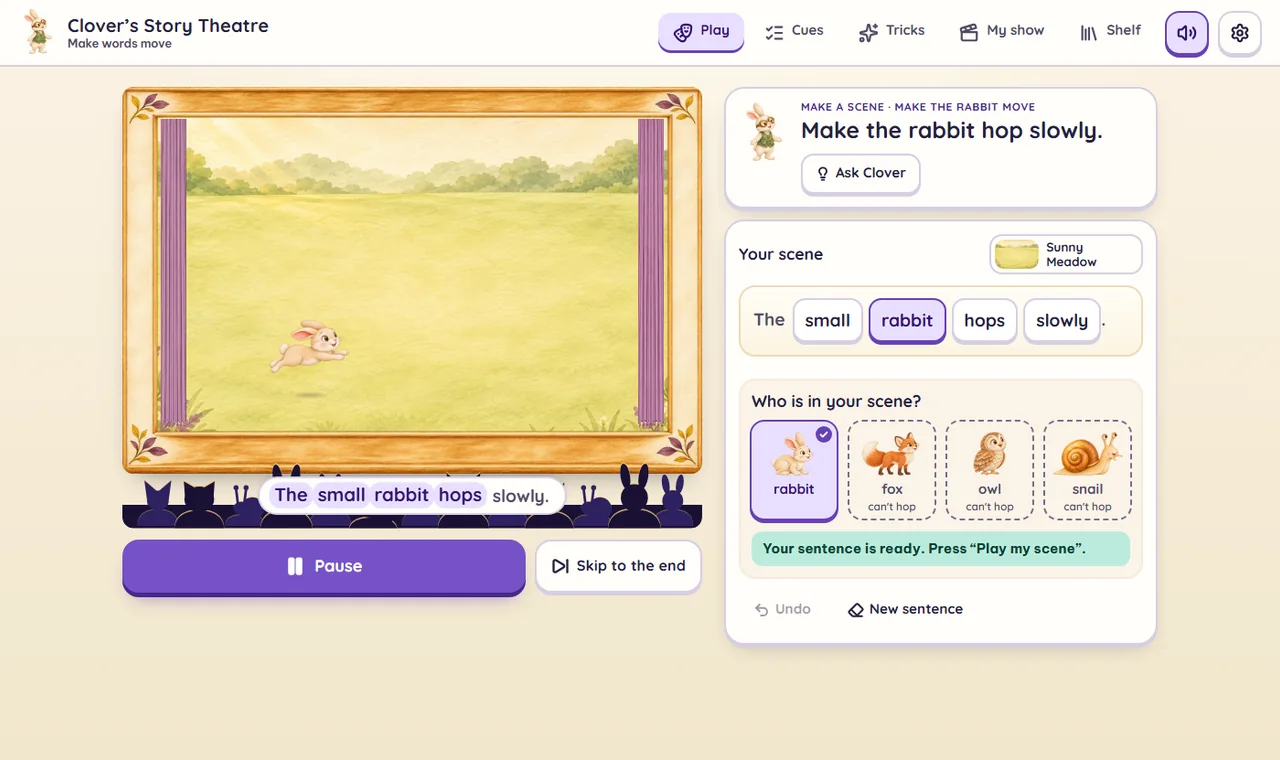
Choose a rabbit, a fox, an owl or a snail. Pick a size, an action and how it moves. Then press Play and watch that very sentence come to life on a little watercolour stage. Change one word, and see exactly what changes.
Play the free gameNo account, purchase or email needed. Touch, mouse and keyboard controls, on phones, tablets and computers.
Choose, play, compare
Every scene is one sentence: who, how big, what it does and how. The words on the screen, the words under the stage and the performance all come from the same sentence, so a picture never says something different from its words. Change “slowly” to “quickly”, or “small” to “large”, and only that changes.
Plenty to come back to
30 cues in three bands of support, 5 kinds of play and 672 different sentences to build. Many answers are right: “small” and “little” are both right for a small animal. A Trick Book keeps every different thing the animals have been made to do, 104 to find in all, and children can make a cue for a friend, try it themselves and keep up to 6 of them. There are no timers, lives, streaks or locked animals.
Keepsakes and a quiet play space
Put 3 scenes in order, choose a title and a paper, keep up to 6 shows, and save a picture of a show to print or share. The play area has no advertising pixels, retail analytics, shop offers or accounts, and what a child makes stays in this browser.
Five ways to play
All 30 cues are open from the start, in any order, and a child can always leave them and just play. The cues come in three bands of support: first performance (2), word explorer (22) and story director (6). The bands are a choice of how much help to have, not levels to unlock.
Make a scene
6 cues
Build a scene that fits the cue.
Find the spot
6 cues
Put an animal beside, behind, in front of or under a prop.
Swap a word
6 cues
Change one word and watch what changes.
Put in order
6 cues
Put three scenes in order.
Be the director
6 cues
Choose three scenes for your own show.
Change one word, see what changed
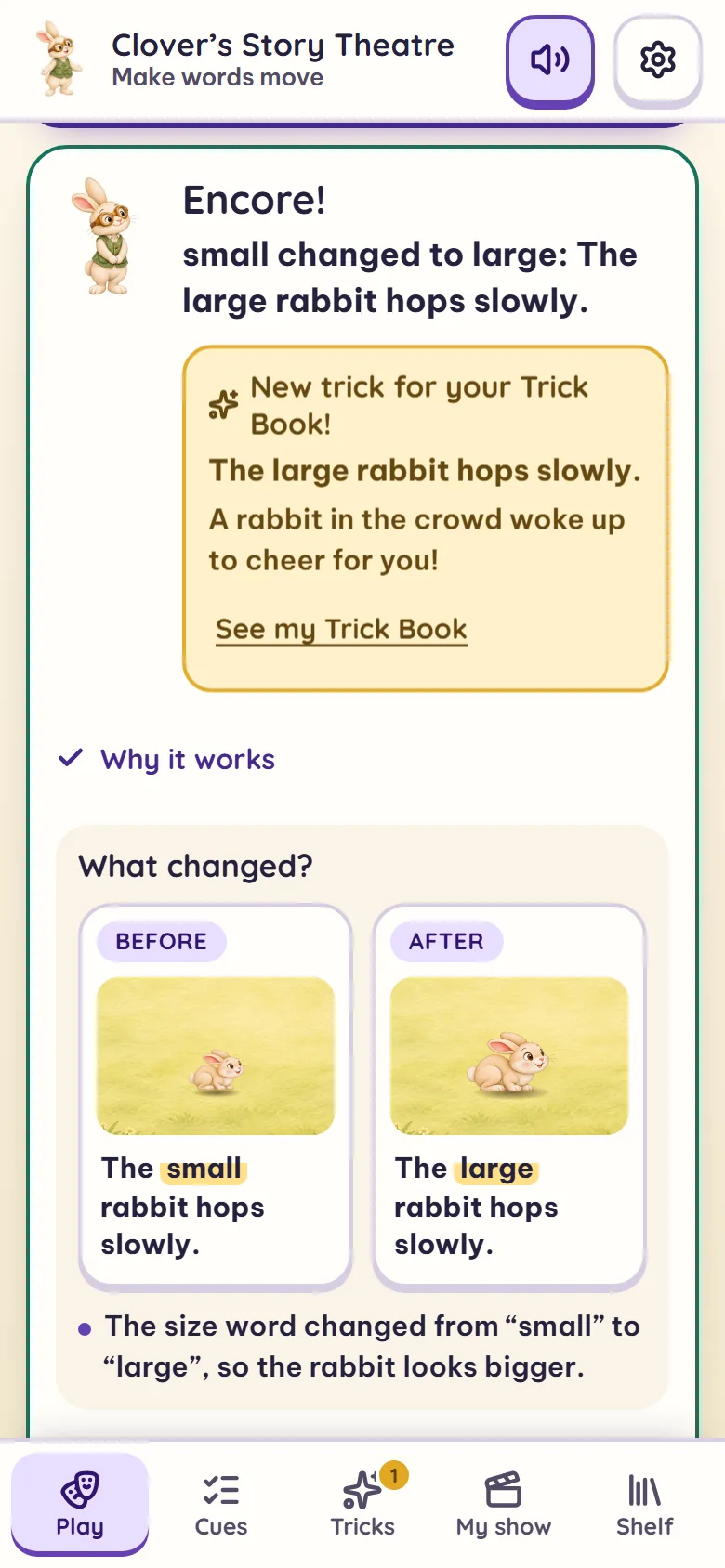
After a word is swapped, the theatre shows the scene before and after, side by side, with the changed word picked out and a plain sentence about what it did to the picture. A small rabbit and a large rabbit are the same rabbit in two sizes. A quick rabbit and a slow rabbit cross the stage in different times. Two words that mean the same, like “quickly” and “fast”, give two pictures that look exactly the same, and the game says so.
Eight word cards
The word cards on the game’s shelf show what a word does to a performance and let a child try it. Grammar words are there to name what a child has just seen, and never have to be known first. They describe how each word is used in these sentences, not what it can ever be: “fast” is a pace word here.
Who is here?
Rabbit and owl name animals. These naming words are nouns.
What happens?
Hops, walks and rests tell what the character does. These are verbs.
Describe the animal
Small and large describe the animal. Here they are adjectives.
Describe the action
Slowly and quickly tell how the animal moves. Here they are adverbs.
Different words, similar meaning
In our size sentences, small and little can describe the same size.
Change the meaning
Small and large contrast in size. Slowly and quickly contrast in pace.
Where is the animal?
Beside, behind, in front of and under tell where our performer is.
First, next, last
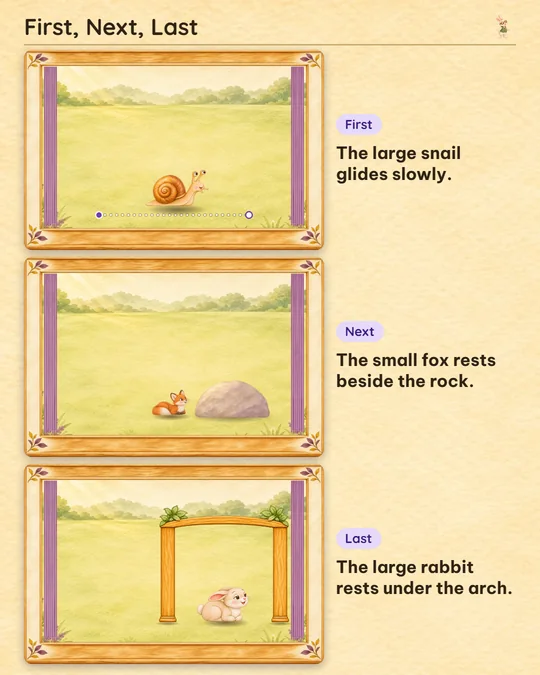
The order of scenes changes the performance. Follow the cues, or invent your own story.
A poster of the show to keep
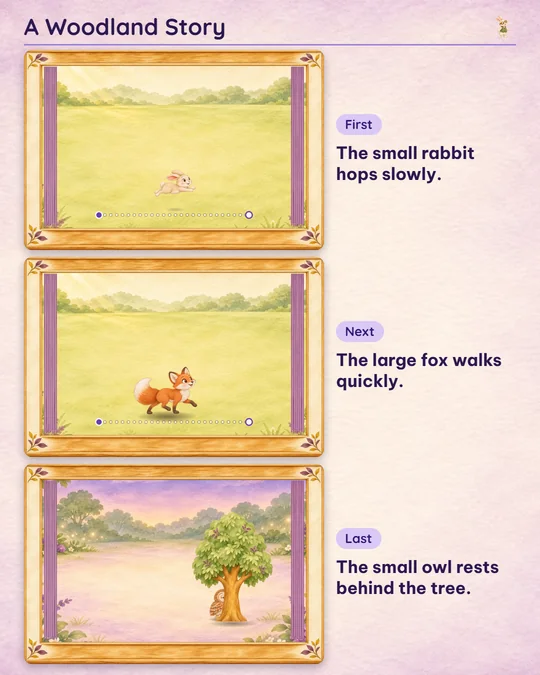
A finished show of three scenes can be saved as a portrait picture (1080 by 1350 pixels). Each panel shows the real scene a child chose, with its exact sentence under it, and the poster carries a title chosen from a fixed list and a paper colour. Children never type names or messages, and a poster never shows a name or a date. It is drawn on the device and saved as a picture file: nothing is posted anywhere.
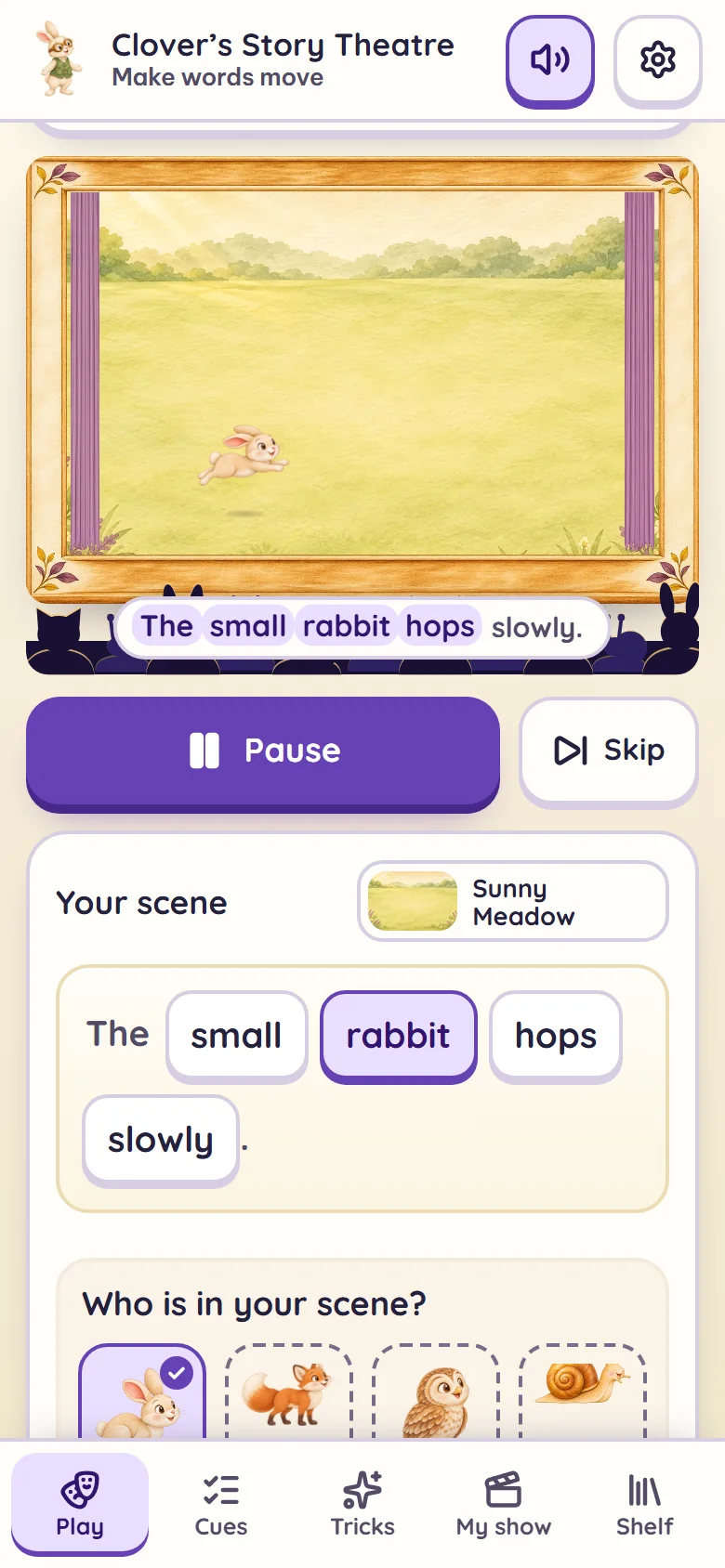
Made for small hands and any screen
The same game fits a phone held upright or sideways, a tablet and a computer. Word buttons are big, every move can be made by tapping (nothing needs dragging or quick reactions), every picture has its sentence written under it, and a hint is always available without a penalty. Reduced motion shows still pictures and a three-step storyboard in place of the animation.
For grown-ups
What children practise
- Noticing that changing one word changes a picture, and that some different words mean the same thing (“small” and “little”) while others contrast (“small” and “large”, “slowly” and “quickly”).
- Choosing who, what and how for a sentence, and seeing it performed exactly as written.
- Position words: beside, behind, in front of and under, shown as real overlap on the stage.
- First, next and last: that the order of scenes changes a story, and that some orders are equally good.
- Making a cue for someone else, and checking that it can be answered.
Designed for ages 5–8 with grown-up support, with the later cues and the challenge-maker for ages 7–10. A cue takes about a minute, and playing freely is always available. These are design targets that are still waiting for playtesting with children.
A theatre, not a test
The theatre does not score a child, count mistakes or keep a streak. When a scene does not fit a cue, it still performs exactly what the sentence says, then says what is different and offers one thing to try. A cue gets a “Played” stamp when a scene fits it, and asking Clover for a hint is recorded quietly and without penalty. A preview of one way to answer proves only that a cue can be answered; it is not stamped as played by the child. Grammar words are optional and describe how a word is used in these sentences.
Besides the thirty written cues, the Cues screen can make up three new ones on the spot, of the kinds a child chooses. They are made from the same words and checked by the same rules, so each one can be answered more than one way, but they are made for now: they are not kept, not stamped and not counted.
The play itself is meant to feel like a toy. The animals answer a tap with a little move of their own (a different one each time, in turn), a few sparkles, a sound and a line of words (“The rabbit says hello.”, which is also read out to a screen reader; with calmer movement it is the sound and the words alone), every word chosen makes a small sound, and a little audience of silhouettes cheers when a scene fits, while the performer takes a bow, and leans in, kindly, when it does not. “Surprise me” in free play sets a whole new scene to watch, and “What if…?” changes just one thing about the scene that was shown (how fast, how big, which animal, where), so a child sees what that one word does, with the two pictures side by side. A short playlist, or three new cues, ends in a curtain call that is always the end of the show: there are no points, timers, prizes, rankings or streaks, and nothing asks a child to come back.
What there is to collect is the Trick Book: 104 tricks, the same number for each animal, one for every different thing it can be made to do (move slowly or quickly, small or large, rest, and rest in each of ten places around the arch, the tree and the rock). A trick goes in the book the first time it is seen on the stage, whatever the cue was, and a spot in the little crowd in front of the stage wakes up for the animal that did it. Surprise me, What if…? and the made-up cues lean towards tricks that are not in the book yet, so there is always something new to find. It is a collection, not a score: a scene that does not fit a cue still counts as a trick, nothing is ever taken away, nothing runs out, and tricks cannot be lost by doing something else. Everything is kept on this device only.
While a scene plays, its sentence is written along the bottom of the stage and each word lights up as the picture reaches it: the animal as it comes on, then what it does, how, and where. It is there so that a child who is learning to read can match each word to the moment it happens; whether it helps is one of the things still waiting for playtesting. With calmer movement the stage stays plain; the sentence is always in the word panel too.
The surprise understudy
Two toys and a cushion, or two people and a chair
Set up. Choose a star and give them a prop to move around.
Say it aloud. “Move slowly behind the cushion, then rest. Ready, star?”
Take turns. Let your child put on the scene. Swap performers and follow the same directions together.
Play it another way. Switch the prop or change just one direction. Let your child direct you.
More ways to play together
- Act out a word: hop slowly, then quickly. What stays the same, and what changes?
- Say “The small owl rests behind the tree.” Use a toy and a cushion to show it, then change one word and show it again.
- Put three toys in order for a little show: first, next, last. Swap two and tell the story again. What changed?
- Find two words that mean almost the same, like “little” and “small”, and one that means the opposite.
Related printables
Printable activities from the shop that explore the same ideas, away from the screen:
Nouns, verbs and adjectives
Parts of Speech Safari Printable Grammar PackThe same word jobs that the game’s word cards show, practised away from the screen.
Vocabulary and word meanings
Synonyms Antonyms Homophones WorkbookPutting things in order
Nursery Rhyme Story Cards Printable for Kids Ages 4–7
The existing guest-checkout flow applies to any purchase. Marketing consent is separate. Playing never subscribes anyone.
Device-local work and privacy
This browser keeps up to 6 shows, 6 of the child’s own cues, the last 30 changes to a sentence, which cues have been played, which tricks have been found and the settings, for this game only. Everyone who uses the browser shares them. Clearing the browser’s data, using a private window or switching device starts a fresh game, and Settings in the game can erase it. There are no child profiles, names, typed messages, dates or cloud saves, and posters are drawn on the device: nothing is uploaded.
Leaving the play room opens this adult page, which uses the site’s normal analytics preferences. The handoff is not legal consent or age verification. See the privacy policy and cookie policy. Before any public launch, hosting logs and the child-directed privacy wording still need an owner review.
Sound, reading aloud and movement
Sound is on when the game opens, but nothing is heard until a child touches something: browsers do not allow it sooner, and the game never tries. The speaker button at the top of the game, and the Sound switch in Settings, turn it off, and the choice is kept. The sounds are small made-up noises (a hello from the animal that was chosen, a hop, a footfall, a wing beat, the curtains, applause) made on the device, not recordings. “Read to me” adds buttons that read a cue or a sentence aloud, only with a voice that is already on the device and only when pressed; no voice service is contacted, and if a device has no such voice the setting says so. Movement follows the device’s reduced-motion setting by default, and Calm shows still pictures: a tap on an animal then answers with its words and sound only, the audience sits still and no confetti falls.
What has been validated?
The game is a play activity, not a measure of ability. Its sentence rules, the checking of cues (including every valid alternative), the saved-game format, the sounds and the poster export are covered by automated tests. Its screens were checked in a desktop browser, and in one set up to behave like a phone, at phone, tablet and desktop sizes, with keyboard-only play and reduced motion, and an automated accessibility scan was run on its main screens (such scans cannot find everything). Posters were saved as real picture files and inspected.
Still needed before any claims about enjoyment or learning: testing on real phones and tablets and with assistive technology, a review of the read-aloud voices, and playtesting with children and their grown-ups. The illustrations were generated with AI image tools from written descriptions and a shared style guide, then checked for size, transparent backgrounds and placement; the Clover pictures are the site’s own artwork. They have not yet been reviewed by an illustrator.
Where the ideas come from
These pages support general ideas about playing with vocabulary, acting out word meanings and putting events in order. They say nothing about this game, its age targets or any learning outcome. Each link was opened on 3 November 2026.
DfE: Exploring language
Playful vocabulary, role play and story performance; not evidence of this game's efficacy.
Common Core L.1.5.d
Acting out word meanings; not a full standards-alignment claim.
Common Core W.1.3
Event order and temporal language; game is not an independent-writing assessment.
DfE: Exploring words
Vocabulary and noticing words in meaningful contexts; phonics remains a separate teaching task.