Clover’s Market Day
Pack, Share & Solve
Visitors come to Clover’s market with a little request: three strawberries, a fair share for four plates, a pattern for the wrapping, a ribbon that fits. Children handle the goods, work it out, and wrap the answer up as a parcel to keep.
Play the free gameNo account, purchase or email needed. Touch, mouse and keyboard controls, on phones, tablets and computers.
Hands-on, not worksheets
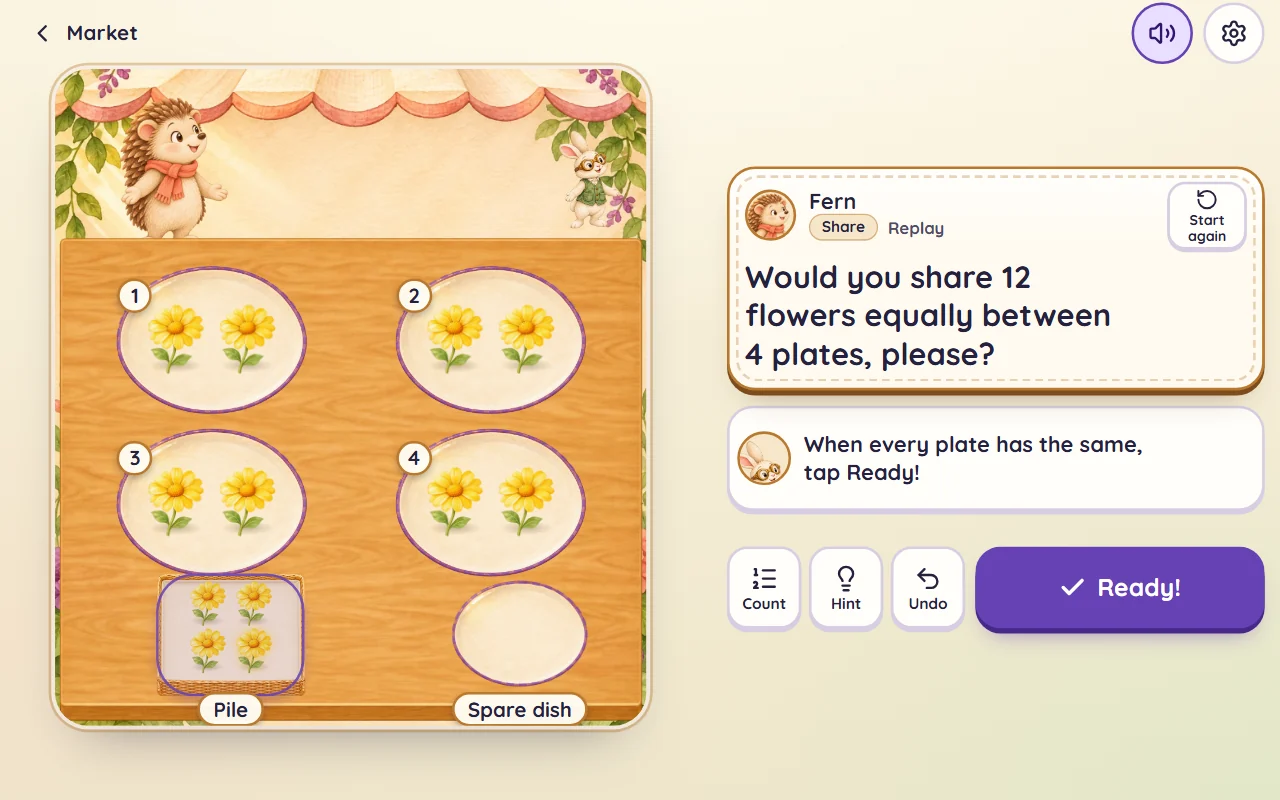
Everything is done by tapping, dragging or pressing keys: put goods in a basket, deal them onto plates, choose tokens, stamp a strip, slide ribbons along a ruler. When something is not right, the visitor and Clover say what they can see, kindly, and nothing is taken away.
Plenty to come back to
12 guided requests and 48 replay requests across six activities, with 4 visitors, free play on every table and a small request-maker. Many requests have more than one right answer: once one is solved, the game offers "Another way" and says why a different answer works too, and a wrapped parcel remembers which one was chosen. A new hour of visitors starts with requests that have not been played yet, and only repeats the ones that have once those run out. No scores, timers, lives or locked levels.
A parcel to keep
Every finished request can be wrapped: choose paper, a bow and up to four stamps, then hand it over. Each visitor has a favourite paper, bow and stamp, and says so when handed one, but any parcel is welcome. Parcels go on a shelf and a picnic cloth, and a grown-up can save any of them as a picture. A parcel made with help says so, and one made in free play is an experiment, never marked as solved.
Six ways to help
Every one of the 60 requests belongs to one of six activities. Nothing is locked: any request can be opened from the list, in any order, and the market can also bring a few visitors at random, filtered by the kind of request or the amount of support.
Pack
Tap goods into the basket until it holds exactly what the visitor asked for.
Counting one by one, and how many there are in all.
Compose
Make a total from two or three kinds of goods, within the limits on the ticket.
Many right answers: 3 and 2 make 5, and so do 1 and 4.
Share
Deal goods onto two, three or four plates. A spare dish holds whatever cannot be shared.
Equal shares, and what to do about the leftover.
Checkout
Pay with leaf tokens worth 1, 2, 5 or 10, exactly or by working out the change.
A token’s value is not the same as how many tokens there are.
Pattern
Stamp a strip so a short group of shapes repeats along it.
Spotting the repeating unit and carrying it on.
Measure
Lay ribbons end to end on a ruler to cover a length, with no gaps and no overlaps.
Measuring with equal units laid end to end.
Made for small hands and phone screens
The play area is laid out for a phone held upright first, with large buttons, goods that stay individually countable, and a plain button for every action a drag can do. These are real screens from the game.
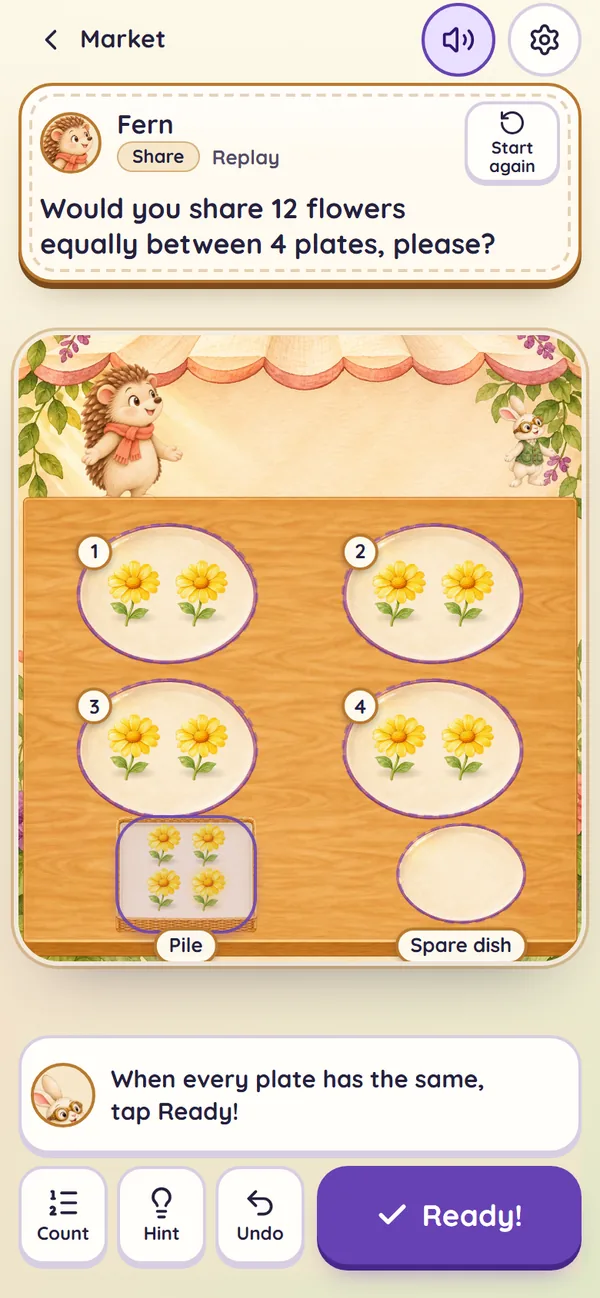
Sharing
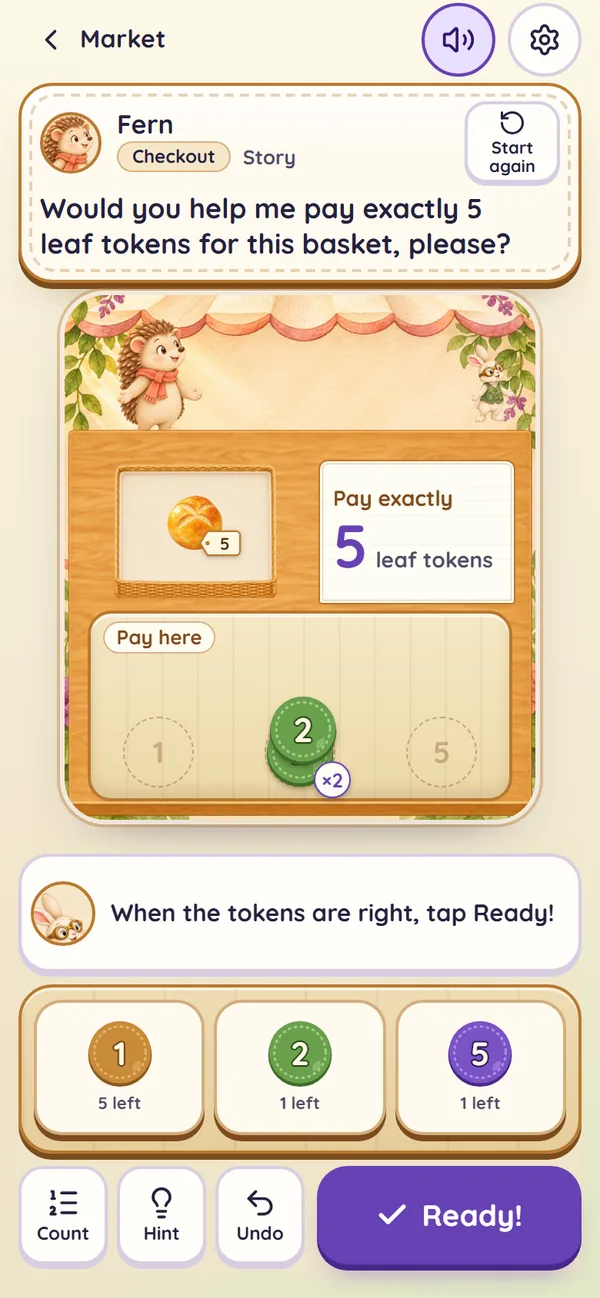
Paying
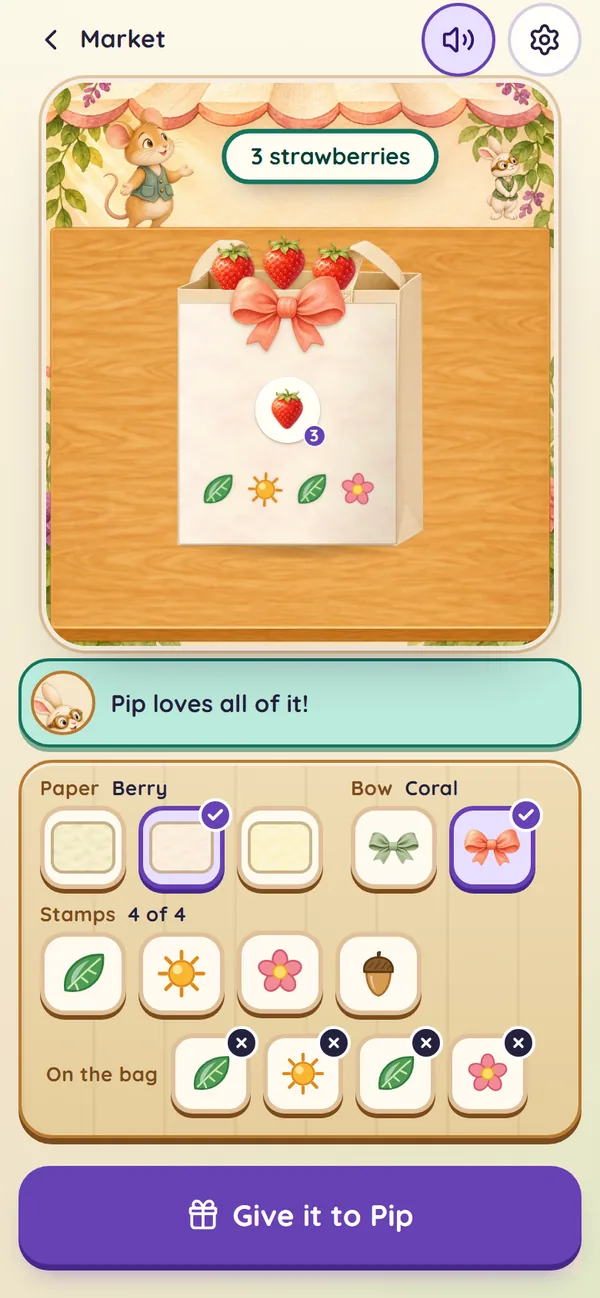
Wrapping
A picture to keep
From the grown-ups page, a parcel, the picnic or a puzzle card can be saved as a 1080 × 1350 picture. It shows the game’s own title, what was made and how it was made, and nothing else: no names, no dates and no way to find a child. It is drawn on the device when asked for and never posted anywhere.
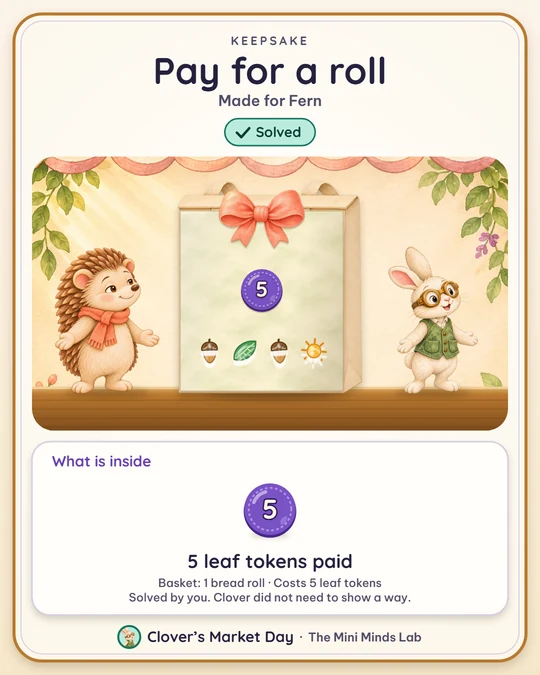
For grown-ups
What children practise
- Packing an exact amount: counting one by one and seeing how many there are in all.
- Making the same total in more than one way, and noticing why some ways break a rule.
- Sharing equally between plates, and deciding what to do with what is left over.
- Telling what a token is worth from how many tokens there are; paying exactly, or working out change.
- Spotting the repeating unit in a pattern and carrying it on.
- Measuring with equal units, laying lengths end to end with no gaps and no overlaps.
Designed for ages about 4 to 8 with a grown-up nearby; the requests about change, leftovers and ribbons that must fit exactly suit about 6 to 9. These are design guesses that are still waiting for playtesting with children. The game does not test, score or report on a child.
Right answers, and honest help
Where a request has several right answers, any of them is accepted, because the game checks the rule and not a stored answer. “Ready!” tells the child what it can see that is not yet right: how many there are, whether the plates are equal, what the tokens are worth, whether the ribbons leave a gap. Hints get more specific in two steps and “Show me how” gives one way, then hands the table back. A parcel made with help says so, and no help is ever needed to keep playing.
Leaf tokens and the prices on the goods are pretend numbers to work with. This is not a lesson about real money, saving or spending.
Swap at the pretend shop
Four toys or sticky notes and eight paper tokens
Set up. Mark an apple at 3, a roll at 5, and two other goods at 4 and 1. Start with the apple and roll in your pretend basket.
Say it aloud. “Keep the apple for our guest. Can you trade the roll for two things without spending more?”
Take turns. Your child shops and you count the tokens together. Switch who runs the shop.
Play it another way. Let your child make the next set of prices. Can they make a swap where two things go back and one goes in?
More ways to play together
- Pack a real bag with exactly 7 things. Then find a different way to make 7.
- Share 8 crackers fairly onto 3 plates. What shall we do with the one left over?
- Pay for a pretend snack with buttons as tokens: 5 one way, then 5 another way.
- Make a pattern with leaves and pebbles, and ask someone what comes next.
- Measure a book with hand-spans, then with paper clips. Why do the numbers change?
Related printables
Printable activities from the shop that explore the same ideas, away from the screen:
Counting and numbers
Skip Counting & Multiplication FoundationsSharing and equal groups
Fractions & Pizza MathMeasuring
Measurement Worksheets for KidsPretend shopping and coins
Money Math Worksheets for Kids
The existing guest-checkout flow applies to any purchase. Marketing consent is separate. Playing never subscribes anyone.
Device-local work and privacy
This browser keeps, for this game only, the settings, which requests have been played, up to 6 parcels on the shelf and the latest few finished ones, up to 6 requests made in the request-maker, and the picnic cloth with its 3 places, plus the table that was being worked on. Everyone who uses the browser shares them. Clearing the browser’s data, using a private window or switching device starts a fresh market, and Settings in the game can start over. There are no child profiles, names, typed messages, dates or cloud saves, and pictures are drawn on the device: nothing is uploaded.
The play area loads nothing from the shop: no advertising pixels, retail analytics, product offers, accounts or third-party requests, and it asks the browser not to send a referrer. Leaving the play area opens this adult page, which uses the site’s normal analytics preferences. The handoff is not legal consent or age verification. See the privacy policy and cookie policy. Before any public launch, hosting logs and the child-directed privacy wording still need an owner review.
Sound, narration and movement
Soft sounds are made on the device and cannot start until the first tap or key press; a sound button at the top mutes everything at once, and sound stops when the page is hidden. “Read to me” is off until it is switched on in Settings. It then adds a Listen button to each request, which reads the words already on the screen using a voice that is on the device, through the browser. No recording or voice service is contacted, and a device with no voice just keeps the words on screen. The game is fully playable in silence. Movement follows the device’s reduced-motion setting by default, and can be set to Calm or Full. Every control that can be dragged also works by tapping, and by keyboard.
What has been validated?
The game is a practice activity, not a measure of ability or mastery. The rules for all 60 requests, including the answers their authors worked out and a set of counter-examples that must be rejected, the saved-game format and the picture export are covered by automated tests, and end-to-end journeys were driven through the real controls on a phone-sized and a desktop-sized browser. The screens were checked at 320, 390, 768 and 1440 pixels wide, with an automated accessibility scan and a check that every control is at least 48 pixels across. WCAG 2.2 AA is the target and has not been certified.
Still needed before any claims about enjoyment or learning: playtesting with children and their grown-ups, testing on real phones and tablets, a screen-reader pass with real assistive technology, and a maths educator’s read of the wording. The illustrations were generated with AI image tools from written descriptions and an approved style guide, then checked for size, transparent backgrounds and placement.
Where the ideas come from
These are general references for the kinds of activity the game uses. None is a claim that the game improves results, or that it meets a standard.
Concrete number/operation progressions and meaningful mathematical contexts; no claim of game efficacy.
Iterated equal length units without gaps or overlaps; no claim of full standards alignment.
Recognising, continuing and creating repeating patterns.
Practical equal sharing in a story context and discussing leftovers.
3 papers, 2 bows and 4 stamps for wrapping, 6 kinds of goods and 4 visitors, all drawn for the game.