Clover’s Habitat Studio
A Little Wild Garden
Build a small wild garden, press Watch, and see who comes to visit. A bumblebee looks for a flower, a frog for a pond edge with cover, a hedgehog for a way in. What does your garden offer, and what is missing?
Play the free gameNo account, purchase or email needed. Touch, mouse and keyboard controls, on phones, tablets and computers.
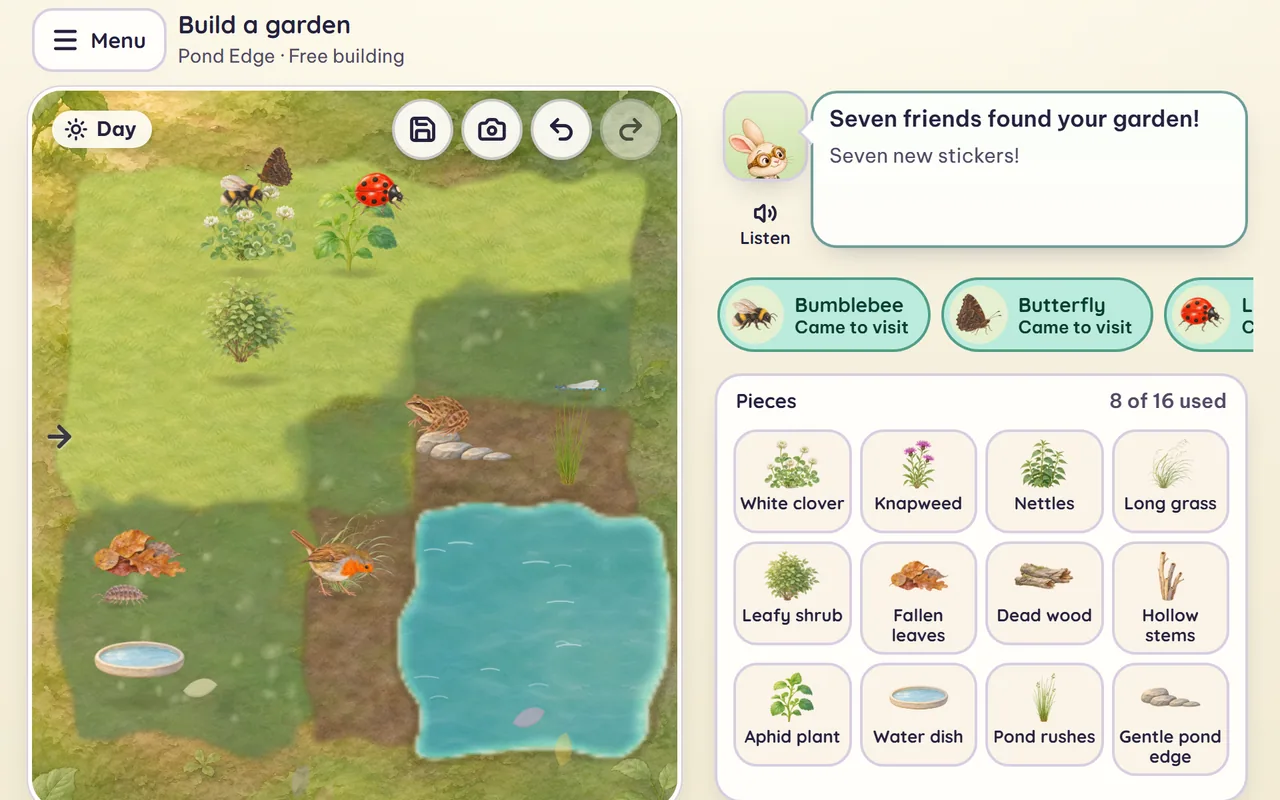
Build, watch, wonder
Choose a sunny meadow, a pond edge or a woodland corner. Place flowers, water and shelter, then watch. Each visitor goes where it finds what it needs, and tapping a visitor shows what it found and why. Change one thing and see who comes, and who does not.
Plenty to come back to
12 garden quests, 18 replay briefs with more than one good answer, free building (start with nothing, or open one of 11 ready gardens and change it) with 6 kept gardens, a Sticker Book of 16 stickers to find, two life journeys (a butterfly and a frog) and a small pass-the-device challenge maker. No scores, timers, lives or locked pieces.
Keepsakes and a quiet play space
Turn any garden into a postcard and save it as a picture. The play area has no advertising pixels, retail analytics, shop offers or accounts, and progress stays in this browser. Sound, narration and movement each have their own switch.
Who might visit?
8 visitors, each with different needs. 12 garden pieces can be mixed and moved, and one piece can help more than one visitor. Some visitors only come by night. A hedgehog needs a way in as much as it needs food.
Buff-tailed bumblebee
Bombus terrestris
Flowers provide nectar and pollen.
Pollen can travel on a bee between flowers.
Peacock butterfly
Aglais io
Adult peacock butterflies feed at flowers.
Their caterpillars eat nettle leaves.
Sources: S03
7-spot ladybird
Coccinella septempunctata
This ladybird eats aphids.
Hollow stems can give adult ladybirds winter shelter.
Sources: S04
Common frog
Rana temporaria
Common frogs use water and sheltered land.
A frog's early life includes an aquatic tadpole stage.
Common blue damselfly
Enallagma cyathigerum
Adult damselflies can perch around ponds.
Before flying, a damselfly lives as an aquatic larva.
Woodlouse
Isopoda (a group of animals)
Woodlice find shelter in damp, dark places.
Feeding on decaying plants helps recycle material.
European robin
Erithacus rubecula
A robin searches for small invertebrates.
Vegetation provides places to take cover.
European hedgehog
Erinaceus europaeus
Hedgehogs usually forage after dark.
Connected gardens let a hedgehog reach useful places.
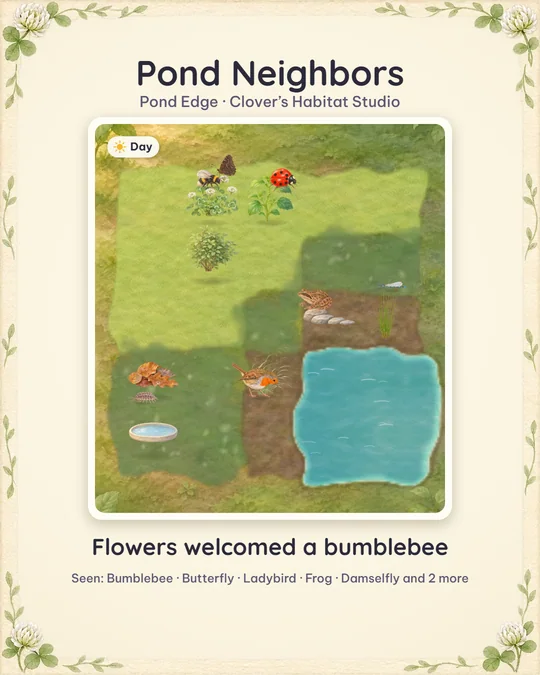
A postcard to keep
A postcard shows the garden as it was left, a title, a short caption and only the visitors that really came. It is drawn on the device and saved as a picture that looks just like the one on screen. Children never type names or messages, and a postcard never shows a name or a date.
For grown-ups
What children practise
- Noticing what a plant or place offers a small animal: food, shelter or water.
- Predicting first, then watching to see: who might visit?
- Seeing that one piece can help more than one visitor, and that a missing piece changes who comes.
- Comparing a garden by day and at night.
- Following two life journeys, a butterfly and a frog, and noticing that a young animal can need different things from an adult.
Designed for ages 5–8 with grown-up support, with optional planning challenges for ages 7–10. These are design targets that are still waiting for playtesting with children.
A model, not a measurement
“Our garden shows a few helpful connections. Real wildlife needs more space, time and many other things.”
The garden is an illustrative British wildlife garden. The game is a designed, qualitative model inspired by the sources below. Grid distances, the 16-piece free-building allowance, instant growth and which visitors come by day or night are rules of play, not facts about real gardens. It does not predict what will visit a real garden, count animals, or say anything about conservation status. Day and night change only what can be seen, not the season, the weather or how plants grow. The game is not a guide to changing a real garden or handling wildlife.
Two frog hideouts
Paper, a cup, and a toy or fingertip frog
Set up. Use paper for a pond. Set a cup on its side for a hideout.
Say it aloud. “Can my frog reach a hiding place from the pond?”
Take turns. Your child places the hideout and you hop the frog there. Swap roles and make a second hideout from folded paper.
Play it another way. Mark a second path and see if you can move the hideout while leaving both paths clear.
More ways to play together
- Look at flowers, leaves and damp corners together, and watch who visits without touching or collecting anything.
- Draw a place where a small animal could shelter.
- Compare a picture from the game with a field guide or a printable.
Please keep real-world activity to looking, drawing and talking. Children should not handle nettles, collect wildlife, dig ponds or move frogspawn.
Related printables
Printable activities from the shop that explore the same topics, away from the screen:
Pond life
Pond Life Discovery PackFrogs
Frogs Discovery Pack PrintableButterflies
Butterfly Life Cycle Science PackSmall creatures in the soil
Under the Soil Discovery PackA different bee
Honeybee Waggle Dance & Hive EngineeringThis one is about honeybees, which are a different bee from the bumblebee in the game.
The existing guest-checkout flow applies to any purchase. Marketing consent is separate. Playing never subscribes anyone.
Device-local work and privacy
This browser keeps up to 6 kept gardens, 6 challenges and 12 postcards, plus the Sticker Book and settings, for this game only. Everyone who uses the browser shares them. Clearing the browser’s data, using a private window or switching device starts a fresh studio, and Settings in the game can start over. There are no child profiles, names, typed messages, dates or cloud saves, and postcards are drawn on the device: nothing is uploaded.
Leaving the play room opens this adult page, which uses the site’s normal analytics preferences. The handoff is not legal consent or age verification. See the privacy policy and cookie policy. Before any public launch, hosting logs and the child-directed privacy wording still need an owner review.
Sound, narration and movement
Soft sound effects are made-up sounds, not animal recordings, and stay off until switched on in Settings. A Listen button reads the words aloud and nothing plays by itself; every spoken word is also written on screen. The narration is computer-generated speech recorded in advance from the on-screen text, so no voice service is contacted while playing. Movement can be set to Calm, and it follows the device’s reduced-motion setting by default. Choose a piece, then a square: dragging is never required.
What has been validated?
The game is a discovery activity, not a measure of intelligence or mastery. Its rules, saved-game format and postcard export are covered by automated tests, and its screens were checked in a desktop browser at phone, tablet and desktop sizes.
Still needed before any claims about enjoyment or learning: a wildlife educator’s check of the facts and wording, a pronunciation review of the narration, testing on real phones and tablets, and playtesting with children and their grown-ups. The illustrations were generated with AI image tools from written descriptions and a shared style guide, then checked for size, transparent backgrounds and placement. They have not yet been reviewed by a wildlife expert.
Where the facts come from
These sources support the identification of each animal and the relationships the game shows, not the numbers in its rules. The list was compiled on 3 November 2026.
S01 · Bumblebee Conservation Trust
Identifying the buff-tailed bumblebee and what it feeds on.
S02 · The Wildlife Trusts
Garden flowers that bumblebees visit, including white clover.
S03 · The Wildlife Trusts and the Woodland Trust
Identifying the peacock butterfly; adults feed at flowers and caterpillars eat nettle leaves.
Peacock butterfly (The Wildlife Trusts) · Peacock butterfly (Woodland Trust)
S04 · The Wildlife Trusts
The 7-spot ladybird, the aphids it eats and hollow stems as shelter.
S05 · The Wildlife Trusts
The common frog: water for breeding, and the land habitat around it.
S06 · Royal Horticultural Society
Gentle pond edges, plants at the water's margin and the habitat beside a pond.
S07 · The Wildlife Trusts
Where the common blue damselfly lives and how to recognise an adult.
S08 · British Dragonfly Society
The damselfly life cycle: a larva that lives in water, then a flying adult.
S09 · Royal Horticultural Society
Woodlice are land-living crustaceans that shelter somewhere damp and eat decaying plant material.
S10 · Natural History Museum
Damp wood and leaves as shelter for small garden animals.
S11 · RSPB
Identifying the European robin and how it behaves.
S12 · British Trust for Ornithology
Natural places where robins find food, and the leafy cover they use.
S13 · The Wildlife Trusts
The European hedgehog looks for food at night and uses cover.
S14 · The Wildlife Trusts
Why animals need a way between gardens. The game teaches the idea of connection, not instructions for changing real fences.
S15 · Bumblebee Conservation Trust
Bees collect pollen and nectar, and pollen can travel between flowers.
S16 · Froglife
Frogspawn and tadpoles develop at different speeds, so the game gives no fixed time.