Clover’s Dino Detective Museum
Fossils, Clues & Curious Creatures
Brush the dust from a fossil clue, keep every card that fits what you can see, repair the museum’s picture and put your finding on display. Sometimes two animals still fit, and “we need another clue” is a good answer.
Play the free gameNo account, purchase or email needed. Touch, mouse and keyboard controls, on phones, tablets and computers.
Look, compare, decide
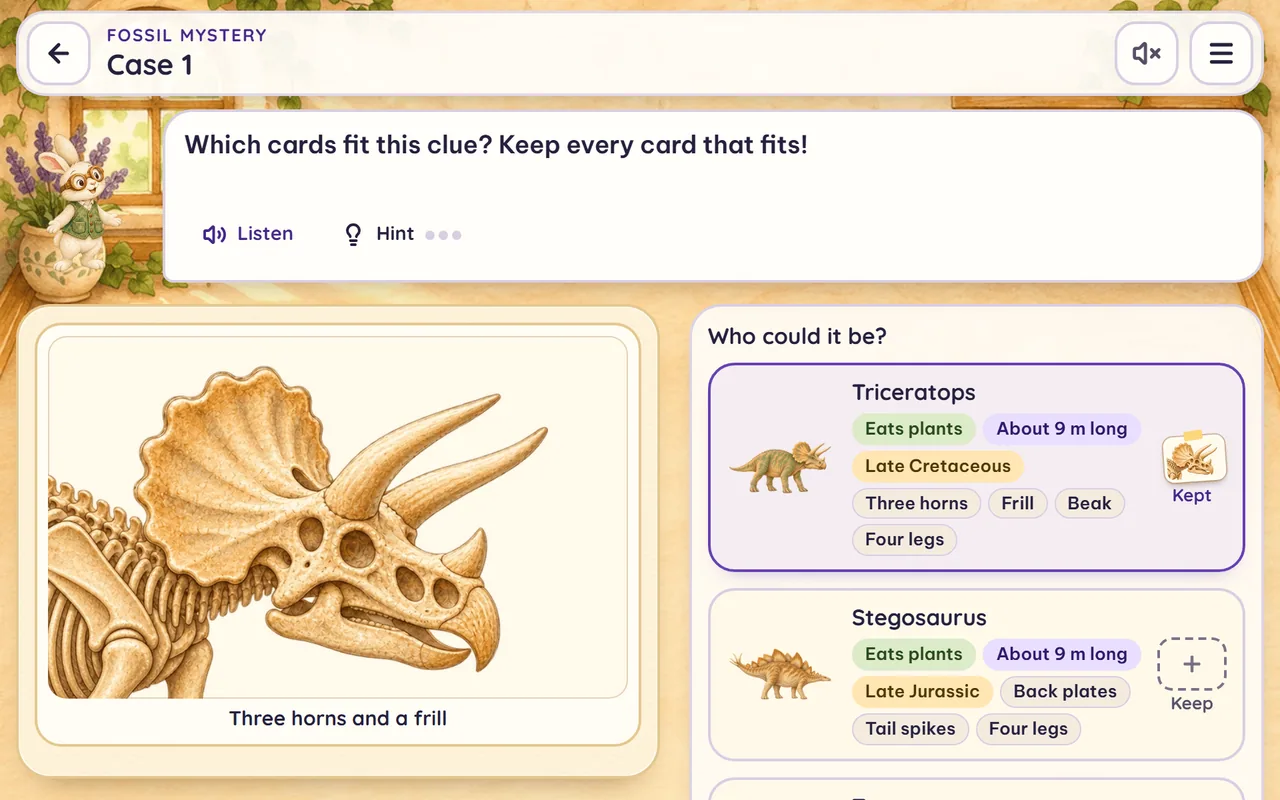
Every case starts with something to look at closely. Uncover the clue, compare it with the reference cards, and keep every card that fits. Then repair the museum’s picture of the animal and imagine it alive. There are no timers, scores or lives, and no “wrong dinosaur” buzzer: a clue that does not fit just sends you back to look again.
Plenty to come back to
12 guided cases and 18 replay cases that can be arranged differently each time, then surprise cases of every kind, put together afresh each time and judged by the same rules as the written ones. They are all made from the same 6 animals, so some will look familiar, but there is always another one to try. There is also a museum with 6 display places and 3 saved museums in 3 colour themes, a guide of 18 cards, and a mystery maker with 6 slots for puzzling someone else. Nothing is locked, and nothing is scored or timed.
Keepsakes and a quiet play space
Save one exhibit on its own card, or the whole museum, as a picture. The play area has no advertising pixels, retail analytics, shop offers or accounts, and progress stays in this browser. Sound, narration and movement each have their own switch.
Five kinds of case
The cases mix, so a session is never just one kind of thinking. Finishing a case can add an exhibit to the museum or a bookmark to the guide.
Investigation
Brush a covered clue, compare it with the reference cards and keep every card that fits. When more than one card fits, look for a clue that helps decide.
Time gallery
Read each exhibit’s museum record and place it in its time chapter. The chapters are not a scale of time, and sharing a chapter does not mean two animals met.
Measuring hall
Line every row up with zero on one ruler, then put the example lengths in order and join the ones that reach the same mark.
Honest labels
Does the evidence support a museum label, contradict it, or not show it? Some questions are left open on purpose.
Curator brief
Choose exhibits that meet a brief for a museum wing. There is more than one right way to do it.
Who is in the museum?
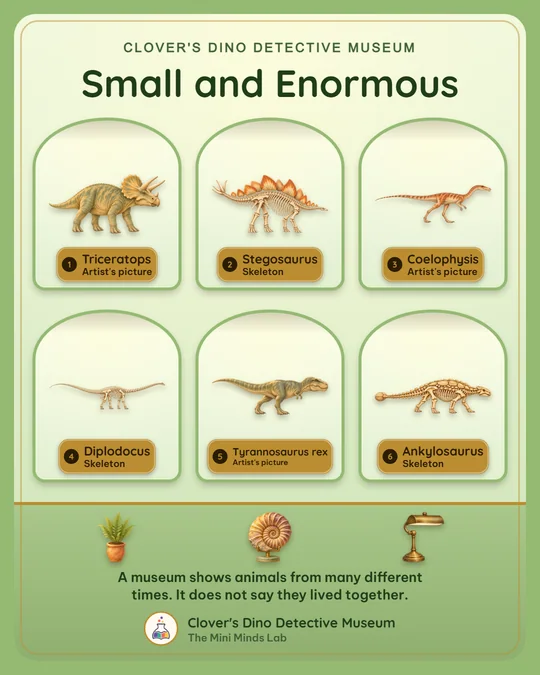
6 animals from 3 time chapters (Late Triassic, Late Jurassic, Late Cretaceous). Lengths are rounded example estimates chosen for this game, not records for every animal of that kind: individuals and published estimates vary.
Triceratops
Late Cretaceous · Eats plants · About 9 m long
A bony frill and three horns help us recognise this dinosaur.
Its beak and teeth helped it eat plants.
Source: Natural History Museum, London
Stegosaurus
Late Jurassic · Eats plants · About 9 m long
Large plates stood along its back; spikes grew at the tail end.
The plates were in its skin. Scientists still debate their jobs.
Source: Natural History Museum, London
Coelophysis
Late Triassic · Eats animals · About 2 m long
This slender dinosaur lived much earlier than T. rex.
Its small sharp teeth helped it eat other animals.
Source: Natural History Museum, London
Diplodocus
Late Jurassic · Eats plants · About 26 m long
Much of its great length came from its neck and tail.
It ate plants. Long does not mean tall or heavy.
Source: Natural History Museum, London
Tyrannosaurus rex
Late Cretaceous · Eats animals · About 12 m long
Its large skull held pointed teeth for eating other animals.
Its fossils are much younger than Stegosaurus fossils.
Source: Natural History Museum, London
Ankylosaurus
Late Cretaceous · Eats plants · About 8 m long
Bony armour covered its body and a club ended its tail.
A full skeleton has not been found; some reconstruction details are uncertain.
Source: Natural History Museum, London
A museum card to keep
A card shows one exhibit, or the whole museum, as it was left: the chosen colours, a title from a short list, and a caption that says what the evidence shows. If a display still fits more than one animal, the card keeps every one of them in its words. It is drawn on the device and saved as a picture that looks just like the one on screen. Children never type names or messages, and a card never shows a name or a date.
For grown-ups
What children practise
- Looking closely at a piece of evidence, then saying what it shows and what it does not.
- Keeping every possibility that still fits, and asking for another clue when one is needed.
- Reading a museum record and placing animals in their time chapters, without treating the chapters as a scale.
- Comparing example lengths fairly, on one ruler that starts at zero.
- Telling a label the evidence supports from one it contradicts and one it cannot show yet.
- Choosing exhibits to meet a brief, where more than one answer is right.
Designed for ages 5–8 with grown-up support, and ages 7–10 for the independent evidence cases and curator briefs. These are design targets that are still waiting for playtesting with children. Nothing in the game needs reading speed or memorising dinosaur names, and every spoken word is also written on screen.
A model, not a measurement
The game is a designed, simplified model of how fossil evidence is read, inspired by the sources below. A drawer of a few reference cards, the clues that can be uncovered, the time chapters and the example lengths are rules of play, not a complete scientific key, and a clue that fits a card in the drawer is not a claim about every dinosaur. When several cards fit, the game says so instead of picking one.
The skeleton pictures and the pictures of the living animals are artists’ reconstructions, and their colours are imagined. Some exceptional fossils do preserve clues about colour, and the game does not claim any for these animals. The 3 chapters (Late Triassic, Late Jurassic, Late Cretaceous) are chapters, not a measured timeline, and animals that share a chapter did not necessarily meet. Flying and swimming reptiles are not dinosaurs, and neither are mammals.
The toy museum
Four toys or scraps of paper
Set up. Make four exhibits. Try a red circle, blue circle, red triangle, and blue triangle.
Say it aloud. “You’re the curator. Find every exhibit that’s red and round.”
Take turns. Check the picks together. Switch roles so your child calls the next rule and you hunt.
Play it another way. Find exhibits that fit exactly one clue. Then try the ones that fit neither.
More ways to play together
- Pick any everyday object and play detective: what can one clue (its shape, its weight, its marks) tell you, and what can it not?
- Mark out an animal’s example length with steps or string, always starting from the same line, and compare it with the length of a room.
- Draw a museum label for a favourite animal that says one thing the evidence shows and one question that is still open.
- Visit a natural-history museum, or look at a fossil in person, if you can.
Related printables
Printable activities from the shop that explore the same topics, away from the screen:
Triceratops
Triceratops Discovery Pack – Printable Dinosaur ScienceComparing dinosaur sizes
Dinosaur Activity Pack for KidsOther prehistoric animals
Prehistoric Flyers & Swimmers Printable PackFlying and swimming reptiles are not dinosaurs, which the game's guide explains too.
Fossils
Geological Time, Fossils & Ancient Eras
The existing guest-checkout flow applies to any purchase. Marketing consent is separate. Playing never subscribes anyone.
Device-local work and privacy
This browser keeps the museum (6 places), up to 3 saved museums and 6 made mysteries, plus the guide, solved cases and settings, for this game only. Everyone who uses the browser shares them. Clearing the browser’s data, using a private window or switching device starts a fresh museum, and Settings in the game can start over. There are no child profiles, names, typed messages or cloud saves, and pictures are drawn on the device: nothing is uploaded.
Leaving the play room opens this adult page, which uses the site’s normal analytics preferences. The handoff is not legal consent or age verification. See the privacy policy and cookie policy. Before any public launch, hosting logs and the child-directed privacy wording still need an owner review.
Sound, narration and movement
Soft sound effects are made-up sounds and stay off until switched on in Settings. A Listen button reads the words aloud and nothing plays by itself; every spoken word is also written on screen. The narration is computer-generated speech recorded in advance from the on-screen text, so no voice service is contacted while playing. Movement can be set to Calm, and it follows the device’s reduced-motion setting by default. Choosing a piece and then a place always works: dragging is never required.
What has been validated?
The game is a discovery activity, not a measure of intelligence or mastery. Its rules, saved-game format, narration files and picture export are covered by automated tests, and its screens were checked in a desktop browser at phone, tablet and desktop sizes.
Still needed before any claims about enjoyment or learning: a palaeontologist’s or museum educator’s check of the facts and wording, a human pronunciation review of the narration (the scientific names especially), testing on real phones and tablets, and playtesting with children and their grown-ups. The illustrations were generated with AI image tools from written descriptions and a shared style guide, then checked for size, transparent backgrounds and placement. They have not yet been reviewed by an expert.
Where the facts come from
These sources support the animals’ features, their time chapters and the example lengths. They do not validate the game’s learning outcomes, illustrations, target ages or gameplay: the finite drawer of cards, the picture cuts and the museum briefs are the game’s own design. The list was compiled on 3 November 2026.
Natural History Museum, London
Triceratops: anatomy, feeding, time and length
Checked 3 November 2026
Natural History Museum, London
Stegosaurus: plates, uncertainty, time and length
Checked 3 November 2026
Natural History Museum, London
Coelophysis: teeth and illustrative 2 m estimate; numeric ages excluded
Checked 3 November 2026
American Museum of Natural History
Coelophysis: Late Triassic cross-check
Checked 3 November 2026
Natural History Museum, London
Diplodocus: body form, time and length
Checked 3 November 2026
Natural History Museum, London
Tyrannosaurus: feeding, time and length
Checked 3 November 2026
Natural History Museum, London
Ankylosaurus: club, incomplete skeleton and armour uncertainty
Checked 3 November 2026
Natural History Museum, London
How researchers learn from fossil evidence
Checked 3 November 2026
US National Park Service
Dinosaur body and trace fossils
Checked 3 November 2026
Natural History Museum of Utah
Some fossils preserve colour clues; limits of reconstruction
Checked 3 November 2026
Natural History Museum of Utah
Pterosaurs are a separate branch
Checked 3 November 2026
Australian Museum
Dinosaur classification, including birds
Checked 3 November 2026
American Museum of Natural History
Mammals and marine reptiles are not dinosaurs
Checked 3 November 2026
The game's own reasoning, not a fossil claim
Logical limit of a broad time grouping; not a fossil claim
Checked 3 November 2026