Clover’s Wonder Lab
Color-Changing Potions
Help Clover solve little mysteries, then make a discovery of your own. One tiny indicator drop reveals a clue. What can it tell us — and what can’t it?
Play the free gameNo account, purchase, or email needed. Touch, mouse, and keyboard controls.
Observe, compare, reason
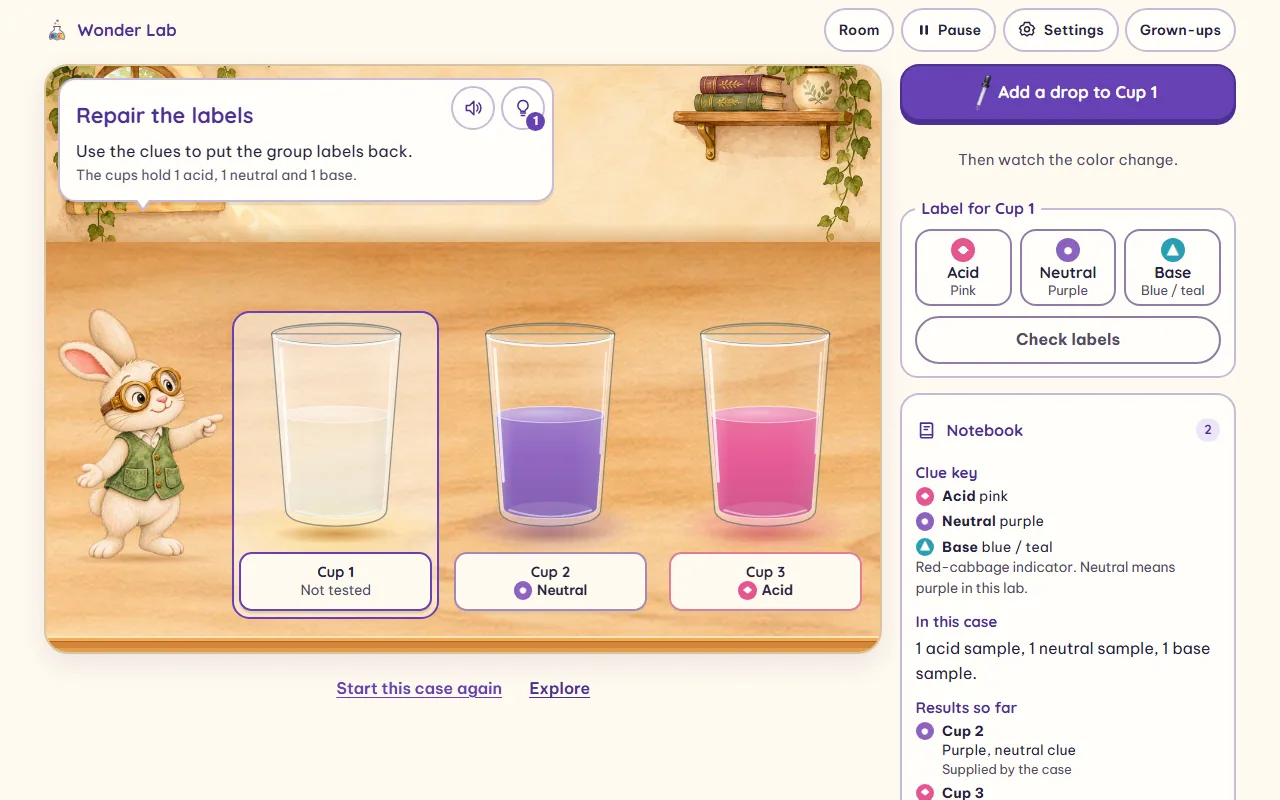
Eight investigations, then thirty curated mysteries in three kinds (repair the labels, find a matching pair, check a claim) that start with the cups in a different order each time. Open exploration points out what the results have in common, and there is a discovery display editor and a small same-device mystery maker. No scores, time limits, or locked decorations.
At your own pace
Designed for ages 5–8 with grown-up support, with optional deeper reasoning for ages 7–10. Choose a cup, add a drop, and look at the clue. Hints change with what has been found so far. Tab, Enter, and Space work throughout. Audio is optional, and nothing needs dragging or quick reactions.
A quiet play space
The play document has no advertising pixels, retail analytics, shop offers, or accounts. Progress stays in this browser. Sound, narration, and reduced movement have separate controls.
For grown-ups
Sock detectives
Four socks or small objects, and a towel
Set up. Put out three with a matching feature and one without it. Cover one before your child looks.
Say it aloud. “Three of these match. Which one is different?”
Take turns. Your child points to a suspect and tells you their clue. Lift the towel together. Let them hide one for you next.
Play it another way. Cover the odd one, then cover one that matches. What changes about the clues you can see?
The game models four fixed prepared samples: water control, lemon, white vinegar, and baking-soda solution. Indicator colors are illustrative and vary in real experiments with preparation and concentration. Pink supports an acidic classification; it cannot identify lemon versus vinegar. The game makes no exact pH claims and does not permit sample-to-sample mixing.
These experiments happen on screen. For real experiments, ask a grown-up, use the activity instructions, and never taste experiment materials. The printable includes separate supervised activities beyond the digital model.
The existing freebie and guest-checkout flows apply. Marketing consent is separate. Playing never subscribes anyone.
Playing together
The game works on its own, and it is better when a grown-up asks a question now and then. Some that fit what is on screen:
- Before a drop: “What do you think this cup will show? What would change your mind?” A prediction is a guess to check, and the game never scores it.
- After a drop: “What did you see? What do we know now that we did not know before?” Seeing a color and deciding what it means are two different steps.
- When two cups match: “Does the same color mean the same ingredient?” Here it does not: lemon and vinegar are both acids, so a pink result only says acid.
- When a cup is untested: “Which cup could we test next, and what would each color tell us?” The hint button gives a nudge that fits what has been found so far.
- On a claim: “Is there a result that would change what Sir Slowpoke says?” “We cannot tell yet” is a good answer when the evidence is not enough.
Nothing is timed or scored, so it is fine to stop and talk. “Choose a mystery for me” moves between the three kinds of mystery, so a long session does not repeat the same kind of puzzle.
Device-local work and privacy
This browser keeps the last stable activity, settings, up to 100 journal entries, six displays, and six mysteries. Everyone using the browser shares that work. Clearing browser data removes it. There are no child profiles or cloud saves. Reset is available in game Settings. Pictures export locally from the game’s Grown-ups area.
Leaving the play room opens this adult storefront page, which uses the site’s normal analytics preferences. The handoff is not legal consent or age verification. See the privacy policy and cookie policy. Public launch requires review of infrastructure logs and child-directed privacy wording.
What has been validated?
The game is a digital discovery activity, not a measure of intelligence or mastery. Child usability and return-session playtesting are still needed before making claims about enjoyment or learning gains. Real-world science references: American Chemical Society red-cabbage indicator activity.